Welcome to Ghana Pundit: The Home of Politics and Intelligent Analysis

LATEST:

Grab the widget  Tech Dreams

Insist on Your Right to Education

Uneducated citizenry is like a pitch any game can be played on it. Illiteracy is what has given the politicians in Ghana the chance to fool so many people for so a long a time.

Thursday, June 11, 2009

Bagbin & Ayariga Scramble For Gov't Cars


Mahama Ayariga

NEW. Watch live television from Ghana, the latest Ghanaian movies and OBE TV.After flogging NPP over state vehicles

… Purchase Kubalo tractors for GH¢18,000
EVEN BEFORE the government establishes the veracity or otherwise of the huge allegations against the Minister of Youth and Sports, Hon. Alhaji Muntaka Mubarak, The Chronicle can authoritatively reveal massive loot involving nicodemous sale of state vehicles to government officials at the Ministry of Food and Agriculture. Information from a deep throat source at the Ministry has exposed how state vehicles are being secretly sold to some high prominent officials of the current government at relatively cheaper prices.

The top government officials involved in the clandestine purchase of state vehicles as uncovered by the paper include the Majority Leader of Parliament and MP for Nadowli West, Hon. Alban S.K Bagbin, the Presidential Spokesperson, Hon. Mahama Ayariga, the NDC Member of Parliament for Salaga, Hon. Alhaji Ibrahim Dey Abubakar and one Mr. Iddrisu Alhassan of Walewale, in the Northern Region.

Series of corresponding letters written and signed by the Chief Director and his deputy at the Ministry, Ing. J.K Boamah and G. K. A. Brantuo respectively, to these government officials approving the sale of the various vehicles under the instructions of the sector Minister, also directed the beneficiary personalities to deposit the various amounts of monies into 2KR-2007 Account, at the Bank of Ghana, Accra.

A letter dated March 24, 2009, written and signed by the Chief Director at the Ministry and addressed to the Presidential Spokesperson, Hon. Mahama Ayariga, copies of which are available to the Minister, the Regional Director of MOFA, the Regional Engineer, MOFA, and the District Director of the Ministry at Bawku, and headlined: ALLOCATION OF ONE (1) KUBOTA TRACTOR WITH MATCHING IMPLEMENTS reads. “I have the pleasure to inform you that the Hon. Minister of Food and Agriculture has approved for sale one Kubota Tractor with matching implements to you. The total cost of the package is EIGHTEEN THOUSAND GHANA CEDIS. You are required to make an initial down payment of GH¢10,000 before taking delivery and the balance of GH¢8,000 is to be paid in three installments over a period of three years, starting from the date of delivery of the package to you. The installment are to be paid as follows:1st year-GH¢4,000, 2nd year-GH¢2,000 and 3rd year-GH¢2,000 with a directive that all initial payment and subsequent installment payments should be strictly by Banker’s Draft, payable to Underprivileged farmers -2KR-2007.

The Chief Director’s letter to the Presidential Spokesperson noted that the validity of the offer was 4 weeks, after which date it would be assumed that he is no more interested in the offer and the tractor would be re-allocated to other applicants.

A receipt dated April 15, this year, acknowledging the payment and receipt of an amount of GH¢10,000 from Hon. Mahama Ayariga, by the Chief Director, had been sighted by the paper.

In the same vein, a letter dated March 6, 2009, written and signed by the Deputy Chief Director of MOFA, Mr. G. K. A. Brantuo, on behalf of his boss and addressed to the Majority Leader, Hon. Alban S. K. Bagbin, also confirms the allocation of one Kubota tractor with matching implements to the Majority Leader, at the same amount per the same mode of payment.

A similar letter dated the same day and signed by Mr. Brantuo also approved for the sale of one John Deere 5403 tractor without harrow to one Mr. Iddrisu Alhassan at the cost of GH¢16,075.00 (Sixteen Thousand Seven- Fifty Ghana cedis) under similar conditions of payment.

Yet, another letter by the MP for Salaga, Hon. Alhaji Ibrahim Dey Abubakar and dated March 12, 2009, requested for 3 Kubota tractors with two sets of implement on the terms of one hand half down payment and the balance spread over a period of two years.

“My constituency is basically a farming one with most of the people lacking services of tractors. The acquisition of the tractors will not only enable me to farm, but also assist the peasant farmers with its services,” the letter noted.

The Chief Director of MOFA, acting upon the instructions of the Minister, has also directed all Regional Directors of the Ministry to first receive an approval from the national headquarters before the final issue of any facility.

Meanwhile, investigations by the paper has revealed that the tractors, which are now being sold at cheaper prices to some officials of the current government, were brought into the country from India by the previous administration under the instrumentality of MP for Dome-Kwabenya, Prof. Mike Oquaye, who was a former High Commissioner to India, as part of efforts by the previous government to assist farmers in the country.

A deep throat source within the Ministry has also hinted the paper that other top personalities of the ruling party (names withheld) have allegedly also benefited from the deal.

Meanwhile, the Majority Leader Alban Bagbin has confirmed the allocation of the Kubata tractor to him by the Agric Ministry. Speaking the paper in a telephone interview, the Nadowli West MP said he put in an application for two of the tractors after his attention was drawn to the sale of the vehicles by his colleague MP for Ejura-Sekyedumase, Hon. Yusif Mohammed Pangabu.

Mr. Bagbin noted that his main reason for acquiring the tractor was to enable him offer assistance to various farmers’ group in his constituency, who are engaged in commercial farming.

He claimed there was nothing fishy about the deal because the tractors were put up publicly for sale, adding that similar purchases had been made by some of his colleague MPs and interested farming groups.

The MP would, however, not comment on the price of the vehicles, saying he was only informed in writing about the price and he saw nothing wrong with the negotiation.

Presidential spokesperson, Hon. Mahama Ayariga on his part told The Chronicle that there was nothing illegal as far as the acquisition of the tractors were concerned and that he went through due process in acquiring them.

According to him, he bought the tractors to help poor farmers in his constituency by giving them subsidized fees for ploughing. He said whilst tractors owned by private individuals charged GH¢250 for ploughing an acre of land, he had instructed his people to charge only GH¢100 per acre.

Source:Chronicle

Rawlings cautions Ministers


Former President Jerry John Rawlings, the founder of the National Democratic Congress (NDC), has cautioned officials in government against “ostentatious lifestyles” that would expunge the confidence the people of Ghana reposed in them in the last 2008 general elections.

The founder was particular about the lifestyle of some NDC members of Parliament, government officials and party functionaries and urged them to be prudent in managing the resources of the nation to deepen the honour the party has been enjoying over the years. He entreated them to uphold the values and the principles upon which the party was founded to show Ghanaians the true meaning of ideals of social democracy of the party.

The former President was emphatic, stressing, “Members of our party who are in Parliament and other leadership positions need to thread carefully as they manage national resources on our behalf. We cannot afford to live ostentatious lifestyles while the economy is in tatters and many cannot make ends meet.” He explained, “our people need a sense of confidence that the socio economic development of this country is being tackled with a sense of equity and an understanding that we all have to share in the national cake.

The founder of the party gave this admonishing in the fiery address he delivered at a rally on Friday at Kasoa Old Market in the Central Region. The rally was to climax the activities marking the Party’s week, long commemoration of the 30th anniversary of 1979 June 4th uprising. The uprising was one of the historical events when the Armed Forces Revolutionary Council made up of only junior officers le by about 31 year old flight Lieutenant J. Rawlings, of the Ghana Armed.

Forces rose up and overthrew a corrupt Military junta to sanitise the top brass of the Armed Forces. The uprising which received spontaneous acclamation countrywide was dubbed: house cleaning exercise”. It lasted for three months after which they handed over power to an elected civilian government headed by Dr. Hilla Limann.Touching on the ongoing oil extraction projects he said: We are currently going through the process of producing oil on commercial basis. God willing, this will serve as major developmental take-off for Ghana at a time when cocoa and gold no longer serve as the hens that lay the golden eggs.

The oil discovery comes with its own attendant problems and we have to be wary of oil multi-nationals committing us to contracts that delay the benefits of this national resource for decades. A thorough re-assessment of all contracts signed with international oil companies and a complete disclosure of the benefits to the country is what the people want. Sale of lands within the oil ‘catchment areas has to be regulated and policy instituted to ensure that indigenes within these areas gain meaningful employment and receive requisite training so they can participate in ongoing oil extracting projects.”

Source: GHP

Tuesday, June 9, 2009

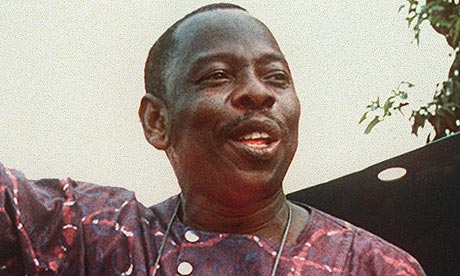
Shell Admits Guilt, agrees to pay $15.5 million to Families of Saro-Wiwa and Ogoni Eight

Ken Saro-Wiwa in 1993

Ken Saro-Wiwa in 1993. Photograph: Greenpeace/AFP

The oil giant Shell has agreed to pay $15.5m (£9.6m) in settlement of a legal action in which it was accused of having collaborated in the execution of the writer Ken Saro-Wiwa and eight other leaders of the Ogoni tribe of southern Nigeria.

The settlement, reached on the eve of the trial in a federal court in New York, was one of the largest payouts agreed by a multinational corporation charged with human rights violations.

The scale of the payment was being seen by experts in human rights law as a step towards international businesses being made accountable for their environmental and social actions.

Jennie Green, a lawyer with the Centre for Constitutional Rights who initiated the lawsuit in 1996, said: "This was one of the first cases to charge a multinational corporation with human rights violations, and this settlement confirms that multinational corporations can no longer act with the impunity they once enjoyed."

The deal follows three weeks of intensive negotiation between the 10 plaintiffs, mainly drawn from relatives of the executed Ogoni nine, and Shell. The oil giant, and its Nigerian subsidiary Shell Petroleum Development Company, continue to dismiss all the claims made against them, saying they played no part in the violence that swept southern Nigeria in the 1990s.

The company said it was making the payment in recognition of the tragic turn of events in Ogoni land. "While we were prepared to go to court to clear our name, we believe the right way forward is to focus on the future for Ogoni people," Malcolm Brinded, a Shell director, said.

The settlement marks the end of a 14-year personal journey for Ken Wiwa Jr, son of the executed leader.

Among the other plaintiffs was Karalolo Kogbara, who lost an arm after she was shot by Nigerian troops when she protested against the bulldozing of her village in 1993 to make way for a Shell pipeline.

Out of the $15.5m settlement, $5m will be used to set up a trust called Kiisi – meaning "progress" in the Ogoni Gokana language – to support educational and other initiatives in the Niger delta.

In the lawsuit, the families of the Ogoni nine alleged Shell conspired with the military government to capture and hang the men. Shell was also accused of a series of other alleged human rights violations, including working with the army to bring about killings and torture of Ogoni ­protesters.

The company was alleged to have provided the Nigerian army with vehicles, patrol boats and ammunition, and to have helped plan raids and terror campaigns against villages.

Supporters of the legal action said the fact that Shell had walked away from the trial suggested the company had been anxious about the evidence that would have been presented had it gone ahead. Stephen Kretzmann, director of Oil Change International, said Shell "knew the case was overwhelming against them, so they bought their way out of a trial".

Among the documents lodged with the New York court was a 1994 letter from Shell in which it agreed to pay a unit of the Nigerian army for services rendered. The unit had retrieved one of the company's fire trucks from the village of Korokoro – an action that according to reports at the time left one Ogoni man dead and two wounded. Shell wrote it was making the payment "as a show of gratitude and motivation for a sustained favourable disposition in future assignments".

Shell's involvement in the oil-rich Niger Delta extends back to 1958. It remains the largest oil business in Nigeria, owning some 90 oil fields across the country. The Ogoni people began non-violent agitation against Shell in the early 1990s under the leadership of Ken Saro-Wiwa and his organisation Movement for the Survival of the Ogoni People. Mosop complained that the oil giant was responsible for devastating the ecosystem of the delta.

Human rights experts believe the settlement will have a substantial impact on other multi-national corporations. Anthony DiCaprio, a lead lawyer representing the Ogoni side, predicted it would "encourage companies to seriously consider the social and environmental impact their operations may have on a community or face the possibility of a suit".Shell reiterated its view that the executions of the Ogoni nine had been "tragic events". It said that it had "attempted to persuade the government of the day to grant clemency"

As the corrupt dictator of Gabon dies, another in Angola is accused of 'squandering oil billions'

Source: The Independent

By Declan Walsh in Luanda


pictured: Omar Bongo died in Spain June 8,2009


As the threat of starvation sweeps across war-ravaged Angola, its secretive government is coming under pressure to explain how billions of pounds in oil revenues have gone missing.

A fresh humanitarian crisis has hit Angola since fighting with Unita rebels ended in April. Three million people are on the edge of famine.

Angola's President, Eduardo dos Santos, has appealed for international help, pleading that his government is broke.

But a swelling chorus of diplomats, campaigners and angry Angolans is asking why he is unable to pay his way out of trouble when his government earns billions of pounds from a burgeoning oil exploration business that will soon rival that of Nigeria as Africa's largest.

And while only a tiny amount is spent on helping suffering Angolans, every year a large chunk of the profits – between 20 and 35 per cent – mysteriously disappears. Last year, for example, the International Monetary Fund estimated the oil revenues at £2bn, of which £750m simply vanished.

Campaigners such as the UK advocacy group Global Witness call it "wholesale state robbery". They say that Angola's vast oil profits are disappearing into the pockets of the Futungo – a secret, powerful élite linked to President dos Santos – on a scale similar to the excesses of the notorious kleptocrat Mobutu Sese Seko of Zaire.

Western oil companies such as BP, Shell and Chevron stand accused of refusing to reveal their annual payments to the Angolan government.

Patrick Nicholson of Cafod, a British aid agency involved in a "Publish What You Pay" campaign, said: "Billions of pounds have gone missing, money that should be used to buy food and medicine and reconstruct the country. Oil companies could play an important part in bringing the government to book."

The campaigners, led by the American financier George Soros, hope that Tony Blair, the French President, Jacques Chirac, and other world leaders will endorse the initiative at the Earth Summit in Johannesburg next week.

In a submission to the United Nations Security Council, a British official pointed out that the UN is struggling to raise £147m for Angola – the equivalent of three weeks' oil profits for the government.

Just where the missing billions have gone is unclear, but the dilapidated streets of Luanda offer some clues. Fleets of the latest BMW, Mercedes and Jaguar cars roar along the sewage-laced roads past the armies of ragged, homeless people on the pavements.

Many are driven by government employees or associates. But it goes deeper. Earlier this year Global Witness published the number of a $1bn bank account in the British Virgin Islands. The money was controlled, it says, by unnamed figures connected to the Futungo.

The Futungo, a cabal of powerful military, business and political figures, is shrouded in mystery. It is thought to consist of about 200 families; analysts refer to it as Angola's "parallel government".

But a glossy magazine called Tropical, sold on Luanda's street corners, offers a glimpse into the lifestyles of the exclusive set. Hello!-style photo spreads show designer-clad Angolans enjoying themselves; the latest issue features parties in London, Lisbon and Luanda.

The extravagance contrasts with the lives of most of Angola's 13 million people, who have slim hopes of getting a job, an education or even staying alive for very long; the average life expectancy is 45.

The ruling MPLA (Popular Movement for the Liberation of Angola) denies corruption but acknowledges the need for changes in how oil money is spent.

But the rot has spread to all levels of governance.In the eastern town of Luena, the medical charity Médecins Sans Frontières has cut aid to the local hospital because supplies kept disappearing. These days it is a dirty place of broken windows and suffering patients.

But the hospital director is doing better. Dr Carlos Alberto dresses in smart suits, wears an Yves Saint Laurent tie and drives a new Suzuki jeep. "The situation is very difficult," he said in his air- conditioned office, the only one in the building. "The support we receive from the government is not enough to cover our problems."

Monday, June 8, 2009

Ghana expands oil adventure


Ghana's National Petroleum Corporation today has issued 11 new exploration licenses, further expanding the exploration rush off its promising coast. First oil revenues are already planned for 2010.

Large tracts of the Ghanaian coast are already being licensed and explored, with a major discovery by Tullow Oil in 2007 causing a rush of interest. Tullow's discovery, the Jubilee Field, will be put into production next year, representing Ghana's first oil production. But only in March this year, the British oil company made a new discovery on the deepwater Tano licence some 25 kilometres west of Jubilee, which has yet to prove viable.

So far, most exploration has been concentrated on the offshore Côte d'Ivoire border area, but oil companies lately have been expanding their drilling activities to the central and eastern parts of Ghana's offshore territory, where promising geological structures and traces of hydrocarbons keeps optimism up high.

The new licensing round by the Ghana National Petroleum Corporation is a continuation of this trend of expanding the exploration area. Ghanaian authorities are eager to make new discoveries as the population's expectations for a new oil economy are rising.

Government has been actively promoting foreign investments in its oil sector, but is also pumping up it National Petroleum Corporation to make sure national capital and labour can take part in the upcoming sector.

As the oil age seems to be coming closer, authorities are now announcing a review of oil and gas policies to avoid similar developments as in Nigeria. Ghanaian Minister for Energy, Joe Oteng-Adjei, only this week called for a review of policies on oil and gas to ensure effective management, guarantee sustainability and protect the environment.

By staff writer

Liberia aid workers 'stole $1m'


Food aid being delivered
Some food aid did get through to the people who needed it

A US-based international Christian relief organisation says it believes more than 90% of its aid to Liberia went missing in a massive fraud scam.

World Vision's Vice-President George Ward told the BBC the losses came to more than $1m and pledged to make "every effort" to avoid a repeat.

A former senior World Vision official in Liberia and two other workers have been charged over the alleged fraud.

They are accused of selling the food in local markets and keeping the profits.

They are also alleged to have used construction materials to build themselves multiple homes using labour provided by US-funded aid workers.

Joe Bondo, a Liberian who was a manager on the project, has been in a Washington jail since his arrest on 20 May.

The Associated Press reports that Mr Bondo, along with two other officials, have been charged with 12 criminal counts, which include fraud, theft, lying to investigators and witness tampering.

Hotline

The scam allegedly began in 2005, as Liberia emerged from 14 years of civil war that claimed some 300,000 lives, displaced more than three million people and left the country's infrastructure and economy in tatters.

World Vision is said to have received an anonymous tip-off about the fraud in early 2007, and sent auditors to 258 Liberian towns believed to be benefitting from the programme.

Mr Ward told the BBC's Network Africa programme that they could only establish that 9% of the food aid had reached the intended recipients. The AP reports that 34 of the towns did not even exist.

Documentation showing receipt of food aid had been "falsified in the offices of World Vision in Liberia in a very large way," Mr Ward explained.

He said the organisation had now tightened its procedures - including launching a hotline for people to report any wrongdoing - to make such frauds more easily detectable in future.

"We cannot guarantee of course that fraud will never happen again," he told the BBC.

"But we can guarantee that we make every effort to ensure that every dollar, every pound sterling, every euro contributed to World Vision is used in the best possible way and we have an excellent track record in that regard."

Source: bbc online

* The above article has been posted in response to an article by Lord Aikins Adusei in which he questioned why Africa is still poor despite the fact that there are hundreds of aid agencies professing to be helping the poor.

Sunday, June 7, 2009

Obama to the Thieves and Tyrants: You must rule by consent of the People


The following is an excerpt from President Obama's speech in Cairo, Egypt in which he spoke directly to the tyrants and thieves in Africa and the Muslim World about democracy and rule by the consent of the people.

“I know there has been controversy about the promotion of democracy in recent years, and much of this controversy is connected to the war in Iraq. So let me be clear: no system of government can or should be imposed upon one nation by any other.

That does not lessen my commitment, however, to governments that reflect the will of the people. Each nation gives life to this principle in its own way, grounded in the traditions of its own people. America does not presume to know what is best for everyone, just as we would not presume to pick the outcome of a peaceful election. But I do have an unyielding belief that all people yearn for certain things: the ability to speak your mind and have a say in how you are governed; confidence in the rule of law and the equal administration of justice; government that is transparent and doesn't steal from the people; the freedom to live as you choose. Those are not just American ideas, they are human rights, and that is why we will support them everywhere.

There is no straight line to realise this promise. But this much is clear: governments that protect these rights are ultimately more stable, successful and secure. Suppressing ideas never succeeds in making them go away. America respects the right of all peaceful and law-abiding voices to be heard around the world, even if we disagree with them. And we will welcome all elected, peaceful governments – provided they govern with respect for all their people.

This last point is important because there are some who advocate for democracy only when they are out of power; once in power, they are ruthless in suppressing the rights of others. No matter where it takes hold, government of the people and by the people sets a single standard for all who hold power: you must maintain your power through consent, not coercion; you must respect the rights of minorities, and participate with a spirit of tolerance and compromise; you must place the interests of your people and the legitimate workings of the political process above your party. Without these ingredients, elections alone do not make true democracy.”

Excerpt from Obama’s speech in Cairo, Egypt.

Compiled by Lord Aikins Adusei

Thursday, June 4, 2009

Electoral Commission and Afari Gyan deserve Nobel Peace Prize

There are few institutions in Ghana and in Africa that can hold its head high when it comes to discharging dispassionately its constitutionally mandated duties and many are under performing or have no accomplishments due to corruption, partiality, and inability to stand the pressure from politicians. However, Ghana’s Electoral Commission has been just one of the few to have defied all those negativities. The Commission stands tall among all the civic institutions in Ghana and Africa tasked with preserving democracy, political pluralism and constitutional rule. It is one of the few institutions in the continent that has not given in to political pressure, threats and intimidations which have brought violence and destruction to so many countries in the continent.

The peace and tranquillity enjoyed by Ghanaians today and envied by so many countries in Africa would not have materialised had it not been the good work of the Electoral Commission and its Chairman Dr. Kwadwo Afari Gyan. For 18 years beginning in 1992, the Electoral Commission has helped to organise five consecutive free and fair elections a record that can only be matched by very few electoral bodies in the continent.

Through the gallant performance of the EC, Ghana has come to be seen as the little white dot on a big black map. The country has been hailed as the beacon of hope for Africa and described as the burning spear and guiding light of the Continent. Ghana has become an icon and a brand name in Africa and the democratic world. She has become the most spoken name in the world of democracy and all lovers of democracy, freedoms and rights in the world now draw inspiration from her achievements and many nations want to be associated with her. Ghanaians and their leaders are held in high esteem across the world.  But all these accolades would not have become possible without the tireless and crucial role of the Commission. Through its crucial role the Commission has helped to build and shape the image of the country as a democratic, peaceful and tolerant nation.

Electoral Commission and its leadership have faced two great challenges (tests) in the past 18 years but have managed to sail through with distinction.

The first test came in the 2000 elections when the poll became fierce and competitive between the then ruling National Democratic Congress candidate Prof Evans Atta Mills and the opposition New Patriotic Party candidate John Agyekum Kuffour, forcing the elections into a run off. The nature of the contest had the potential to turn the elections into violence and instability similar to those in Zimbabwe, Kenya, Somalia and elsewhere. But not shivering and not bowing to political pressure, the head of the Commission decided to let people’s choice and the interest of the nation stand above party interests and declared the opposition candidate winner, which was the first to happen in the whole of West Africa if not the whole of Africa. The timely intervention and the umpire role played by the Commission helped to avert the potential bloodbath between supporters of the two political parties.

The second test came in 2008 when the contest between the ruling party candidate Nana Addo Dankwa Akuffo-Addo and the opposition National Democratic Congress candidate Prof John Atta Mills became so fierce that the onus came to lie on the commission. Then again the Electoral Commission stood firm and decided to allow the aspirations of the people to have priority over those of incumbency and political parties. The Commission therefore declared the opposition candidate winner of the elections after a fierce contested run-off.

The decision of the Commission to stand firm and not collapse under the weight of political pressure, threats and intimidation by political parties has enabled peace to prevail in the country. It has helped to brighten the image of Ghana as a peace-loving country and a country that has opted for a genuine democracy instead of despotism, scant elections and fruitless power-sharing deals which have become entrenched in many parts of the continent. Through its role Ghana has become an Island in an ocean full of political and elections violence, bloodbath and instability. The impartial role the Commission has played since 1992 has helped to reinforce Ghana’s reputation as haven for peace, justice, development and save investment.

The Commission is the single authority that has helped to preserve the Constitution of the Fourth Republic, nurture democracy and has helped to rekindle the bright star that Ghana came to symbolise when she became the first country south of the Sahara to gain independence and in the process lifted the hope and aspirations of millions of coloured people and Black Africans in particular throughout the world.

The Electoral Commission has come to symbolise fair play, transparency, accountability, honesty, justice, independence, integrity, selflessness, openness, objectivity and strong leadership and is idolised by many institutions in Ghana, Africa and the World.

Such courageous display of showmanship should not therefore go unnoticed. Since the Nobel Peace Award is for those who have contributed to world peace and tranquillity, there is no doubt Electoral Commission has all the credential and qualification that entitle it for such an award. The Commission therefore deserve to be awarded the Nobel Peace Prize for the way it has helped to nurture Ghana’s democracy, maintain peace and tranquillity in the country and has helped to avoid the blood bath that has become so common in Africa during and after elections. The achievement of the Commission has made a role model for the rest of the electoral institutions and civic organisations in Africa and recognition by the Nobel Peace Committee will prompt other electoral bodies in the continent to work to ensure that elections are conducted in a transparent manner free from political interference and incumbency manipulation.

The choice of Ghana as the only country south of the Sahara to be visited by President Obama would not have materialised had it not been the tireless effort, exemplary leadership, and the independent role played by the electoral commission. I therefore want to use this piece to urge the Nobel Peace Committee to consider Ghana’s Electoral Commission and its head Dr. Kwadwo Afari Gyan as candidates in the 2009 Nobel Peace Prize for without them Ghana would have joined her neighbours and the rest of the continent in the usual bloodbath, violence, political instability, death and infrastructure destruction and economic collapse.

I also want to urge the government of Ghana to bestow the highest civilian honour of the state on Dr. Kwadwo Afari Gyan and his Commission for the peace they have helped Ghana to build and enjoy. A statute should be erected Dr. Gyan’s honour and a street named after him for excelling in his role as the head of the Commission.

I also want to encourage the leadership of other institutions such as Commission on Human Rights Administrative Justice, National Commission for Civic Education, Customs, Police Service, the Armed Forces, Judiciary, Parliament and the Executive to emulate the Electoral Commission and the its leadership for making it possible for Ghana to enjoy 18 years of unadulterated constitutional rule and peace. As the world congratulates Ghana for holding free and fair elections we must not forget those who made it possible.

By Lord Aikins Adusei

The author is a Political Activist and Anti-Corruption Campaigner.

Feature: The mirage of the African Union

Countries across the African continent devoted May 25 to the observance of the so called African Union´s Day.
Countries across the African continent devoted May 25 to the observance of the so called African Union´s Day
Countries across the African continent devoted May 25 to the observance of the so called African Union´s Day. Few countries, though, have declared the day a holiday and celebrated as such to the neglect of the millions of many hours that could have been put to productive use. Little was heard of the challenges and potential progress that the continent could make in the face of austere financial difficulties. It was the grumpy old self-delusory target of ridding the continent of coup makers and now, state-sponsored terrorism. 

Amusingly, Eritrea was the only culprit fingered and suspended for the latter charge whilst others such as Sudan, Madagascar and Mauritania, renegades of true democracy are still plying their violent and near-violent trade against ordinary citizens. 

And Eritrea replied, calling the AU a full house of disenchanted musical chairs, notoriously toothless and straight-jacketed thinkers. Eritrea might just be right. For, how is it that the recently elected AU Chairman, Col. Muammar al-Gaddafi made an embarrassing mockery of democracy on the continent when he stated in a keynote address at an AU summit at Addis Ababa, that democracy in Africa only leads to bloodshed. This could be a thought trend for African leaders. In 2005, www.Africanliberty.org editor and executive director of IMANI, Franklin Cudjoe, and debated former Tanzanian President Benjamin Mkapa on the latter´s call for an African clone of democracy and the need to fear globalisation, as it was the final undoing of the continent after slavery and colonialism had their way. 

So what else is the AU, an avowed claimant of continental unity, has little to show for? The AU envisages a political and economic integration across all borders devoid of poverty, conflicts, and diseases. Naturally, the various regional economic groups will strive for integration before the entire continent is united. Such a union could affect the livelihoods of the 800 million plus Africans. But we in Africa are our own friends of protectionism. Nigeria and Ghana, next door neighbours within the Economic Community of West Africa still trade in protectionist goods, with Nigeria still maintaining a near-ban of some 74 Ghanaian products from entering Nigeria, while Ghana is demanding hefty down payments for Nigerian tradesmen to enter the Ghanaian market. But Ghana is awashed with Nigerian banks. The Commission for Africa Report 2005 sadly asserts that shipping a car from Japan to Abidjan, Côte d´Ivoire, for example, costs $1,500. Shipping the same car from Abidjan to Addis Ababa, Ethiopia, costs $5,000. Removing regional trade barriers would earn Africa an extra $1.2bn a year, according to the World Bank. 

Instead of focusing on removing the log in the eye of the continent, the AU has a mindset that trade ought to be a one-way traffic, with richer countries who also erect annoying barriers to our produce. It is instructive to know that the global economic difficulties have lowered consumer confidence in rich countries and by extension slowed all agri-export-led economies. In April this year, the World Bank Vice-President for Africa Region, Ms Obiageh Ezekwesil, noted that at the beginning of 2008, Africa´s growth rate which was projected at 6.4 per cent dipped to 4.9 per cent. The rate for 2009 now stands at 2.4 per cent.

However, the cacophony of asking for help to weather the raging storm of economic recession has taken centre-stage in the global discussion of stimulus packages. And African leaders are asking for stimulus packages from the staggering West instead of stimulating critical thinking on how to build their own economies from within. However, it seem to have emerged from a recent Economic Conference in Dakar, Senegal, that they are going to rely more on home-grown solutions to these and other problems. These solutions lay not in imposing additional taxes on the 30% visible businesses and small formal sector workers, but ensuring that the close to 70 % of Africa´s underground economy is unearthed and nurtured with low business entry rules, and perhaps taxed a low flat tax regime. Increased corporate taxes on perceived ostentatious products ought to be reflective of the wider implications for government´s own revenue and employment figures. Already many great performing companies on the continent are not salivating at losing employees. An additional tax burden will leave companies no choice but to lay people off. 

Ordinary Africans must help African leaders to use AU day to reflect on how to reduce economic intervention in our lives, sensibly regulate financial markets, remove bureaucratic obstacles to setting up businesses, establish property rights and enforce contract law. These are the forces that release entrepreneurial energy to see us through the financial meltdown. There is only one reason why African leaders will do these things- when they are forced to do so as a condition of aid which despite its towering failure to reduce poverty on the continent continues to be supported by activists, whose livelihoods depend on it.


Credit: Franklin Cudjoe (Executive director of IMANI, a Ghanaian think tank. He also edits www.AfricanLiberty.org)
Alhassan Atta-Quayson (A graduate student in economics and writes for www.AfricanLiberty,org

Sekyi Hughes rejects ‘stolen’ items

Former Speaker of Parliament, Ebenezer Sekyi Hughes


The former Speaker of Parliament, Ebenezer Sekyi Hughes, says he is no longer interested in all the items he took away from his official residence on his retirement.

In a letter dated 25th May 2007 signed by Atta Akyea on behalf of his (Hughes’) solicitor – Zoe, Akyea & co – to the Parliamentary Service Board, it described as unfortunate the twist, including, criminal undertone being read into his action.

“Our client states categorically that he is no longer interested in the items he took from the Speaker's official residence, bona fide.”

The reason by the former third most powerful person in the country to return all the items was “for the sake of good governance, the integrity of the high office he previously occupied and in good conscience”He has therefore called on the Board to arrange for the collection of the items from his private residence in Accra, “at your earliest convenience, on agreed time schedule”. 

Even though the letter felt short of mentioning names, it reiterated the reasons why he took away those furnishing and other amenities on 26th February 2009, in leaving his official residence.

“It is on record that some retiring and exiting leaders and officers of Parliament have in the past benefited from this practice.”

The letter further stated: “Unfortunately, this claim of right, has generated some furore. Our client attempted to clear the misinformation and to set the records straight. 

“For some strange reasons, it appears that the misinformation has sunk rather very deep to the extent that the hard-earned reputation of our client is being tarnished. 

“It is regrettable that well-placed and responsible men in authority are even imputing criminality to him.” 

The letter concluded with a clarion call to the Parliamentary Service Board to resolve the “unfortunate matter” using “highest sense of professionalism”.

Meanwhile, Mr Asiedu Nketia, NDC General Secretary, told Joy News he still stands by his earlier conviction that the former speaker should be prosecuted.

He said the latest decision by Mr Sekyi Hughes rather “makes the matter muchmore interesting and makes my call more relevant”.

He questioned why Mr Hughes has decided to back out, if he claimed he was right to rip off virtually every property in his official residence while leaving office.

Mr. Nketia, a former Member of Parliament for Wenchi West, challenged the former speaker to go to court if he felt slandered.

Story by Isaac Essel 
Source:myjoyonline.com

Mills: We'll apply due process in demanding accountability


The president John Evans Atta Mills has reiterated proper procedures will be followed in holding former government officials accountable for their stewardship.

He was addressing chiefs and people of Mamprusi in the Upper East Region as part of a four-day official visit to the region.

Some members of the former government including ex-Chief of Staff, Kwadwo Mpiani, and ex-Foreign Minister Akwasi Osei Adjei have been penciled for prosecution for various acts of misconduct.

But the decision has provoked tension with the opposition which is alleging political victimisation and persecution.

“The fact that a government has been booted out of office does not excuse them from accounting to the people,” the president said, adding that members of his government are not excluded from the principle of accountability.

He took a swipe at the erstwhile New Patriotic Party who he said were putting undue pressure on the government.

“People who stayed in power for eight years are putting pressure on us to provide everything in four months.”

The president promised the people of the Upper East Region a sustained development and an improvement in the standards of living of the people.

As part of measures to develop agriculture in the region, the president promised to subsidise prices of fertilisers for the farmers, as well as provide machines and other equipments for mechanized farming.

He also promised to open up access roads to the Upper East Region.

The president early on in the day paid courtesy calls on party executives as well as DCE’s in the region.

Source:myjoyonline.com

Ex-Speaker Saga: Baako Demands full Disclosure

Editor-in-Chief of the New Crusading Guide Newspaper, Kweku Baako Jnr. has demanded full disclosure from the Parliamentary Service Board (BSD)in the case of the unbridled saga of soft furnishings that has rocked the country's law making body.

Ex-speaker, Ebenezer Sakyi-Hughes has been accused of looting state property after he took away soft furnishing at his official residence as part of his retirement benefits.

His action, for months has provoked huge public outcry and media reviews most of which have not only attacked his person and reputation but attributed criminality to it.

On Joy FM’s news analysis programmes News File on Saturday, Mr. Baako said “there is a streak of inconsistencies, double standards and hypocrisy underlying this whole controversy.”

“And I’m not satisfied with the disclosure that has come from the angle of PSD.”

According to the ace journalist, certain personalities were beneficiaries of soft furnishings and finds it difficult why a single individual would be singled out for vilification.

So far, one person, a former clerk of parliament, Mr. Takyi has been mentioned by the majority leader, Alban Babgin as haven benefited in the past from similar arrangements.

The former Majority Leader, Abraham Osei Aidoo in an interview also admitted publicly of keeping his soft furnishings even after he lost his seat.

‘If there is no policy, under what dispensation did these people go home with their soft furnishings?”

“Have they been asked to return their soft furnishings?” he quizzed.

According to Baako, he has evidence to show several other leaders in parliament benefited under similar dispensation and some even bought their official bungalows, cars in 2001 as part of their retirement benefits.

He demanded full disclosure from the PSD, failing which he will make those names available to the public.

“I believe that if the nation really thinks this whole idea of public officers exiting from officers with certain benefits like soft furnishings and other attachments are not good enough it can be reviewed, he said.

But the deputy Information Minister, Samuel Okudzeto Ablakwa who was one panellist on the programme had a completely different assertion.

He said “politicians must respect the sensibilities of the people. If we claim we represent the people and hold the mandate in their trust then we must always be sensitive to their sensibilities and their concerns”

“We live on the taxes of the people and if they frown or are outraged at the things we do, we must be forthright and apologise.”

Comparing the Sakyi Hughes controversy to that of the UK parliament the Deputy Minister, questioned the conscience, conduct, and morality of the ex-speaker.

He hinted punitive action will be taken against the ex-speaker.

“The Government will not take all this lying down. This cannot be swept under the carpet.”

Story by Nathan Gadugah/Myjoyonline

Political Looters to blame for Ghana’s Poverty

Accra — "The bane of Ghana's economy is the stealing of state resources by public officials, and unless we stopped this act of looting the country, there is no hope for this country no matter the government which is in power."

This blunt assertion was made by no other person than the "anti-corruption crusader", Hon. Paul Collins Appiah-Ofori, the Member of Parliament (MP) for Asikuma/Odoben/Brakwa in the Central Region.

In an interview with Public Agenda on Media and Development, Hon. Appiah-Ofori regretted that some media houses are abdicating their constitutional responsibility of exposing some of the criminals in the system.

"It is regrettable that some media houses rather go to the defence of some of these criminals instead of exposing them to the hilt. Some of the media practitioners are not principled."

These media houses, he contends, have failed in upholding Article 35(8) which provides that "The State shall take steps to eradicate corrupt practices and the abuse of power". He argues, "The media is part of the State, therefore the practitioners owe it a duty to, at least, curb corruption if not to eradicate it. But if the same journalists turn round to defend those who have been caught in criminal acts then where are we going?"

To Hon. James Klutse Avedzi, MP for Ketu North, media quality is "not up to standard" although they might be doing their best. He blames the unfortunate situation on lack of resources, typical among them being low remuneration of which some unscrupulous people have taken undue advantage of and are using the media for their selfish ends. "They are not paid well, and they can't leave on empty stomachs. While pursuing their work they also look for something that will sustain them.

The Minister for Women and Children's Affairs, Hon. Akua Sena Dansua, was of the view that while the media in Ghana have become very vibrant, some sections disregard the ethics of the profession to satisfy the ego of certain politicians.

She urged journalists to put much premium on developmental issues such as global warming, streetism, child labour, education and health, and shy away from irresponsible journalism characterized by tribalism and personalization of issues.

The Minister recalled that prior to the election, some media houses pushed the nation to the brink of war by churning out highly volatile stories, "but it was God that saved us".

She said the media are an important tool for keeping State agencies on their toes, hence ensuring accountability.

Gifty Klenam, the MP for Lower West Akim, shared similar sentiments urging the media to build their capacity to deliver on their mandate. "Its time the media equipped themselves to articulate the relevant issues that affect development."

She asked the media, for example, to analyse the Economic Partnership Agreement (EPA) and see whether its consequences would be good for the country or not; its effect on the small and medium enterprises (SMEs) should.

Like Hon. Dansua, she called on the media to focus more on development issues by researching and bringing to the fore matters on women empowerment, health and education, among others.

Story by Ebenezer Hanson
Source: The Public Agenda

Ghana Pundit Headline News

E-mail subscription

Enter your email address:

Delivered by FeedBurner

Pan Africa News

Graphic Ghana

MYJOYONLINE.COM

Peacefm Online - News with a vision

The Times - World News

The Times - Africa News

Pambazuka News :Emerging powers in Africa Watch

AfricaNews - RSS News

The Zimbabwe Telegraph

BBC News | Africa | World Edition

Modern Ghana

R.I.P.

R.I.P.

AfriGator

AfrigatorAfrigator